💸 Spend $ 100+ And Save 10% 🎉     💸 Spend $ 100 + And Save 10% 🎉    💸 Spend $ 100+ And Save 10% 🎉     💸 Spend $ 100 + And Save 10% 🎉    

Santiniketani Batik Saree

$76.00

Inclusive Of All Taxes, Shipping

100% SSL Security
100% SSL Security
Made to Measure
Made to Measure
100% Authentic
100% Authentic
Secure Payments
Secure Payments
Free Shipping
Free Shipping
Free Returns
Free Returns
Santiniketani Batik Saree

$76.00

Add to cart

Santiniketani Batik Saree | Pure Mulmul Cotton | Hand Painted Sorutuli Batik | With Unstitched Blouse Piece

This is a hand-painted batik saree. There are printed versions available also. But this one has been hand-drawn by an artist in Shantiniketan. The cloth is mulmul cotton, light and soft. Most of the batik is on the border and the anchal. If you look closely at the edges of the design, you might notice some unevenness. Which is how you can differentiate real hand batik from a machine-printed one. This Bengal batik saree is easy to wear for long hours because it is cotton.  Good for yourself, and good as a gift.

Product Highlights

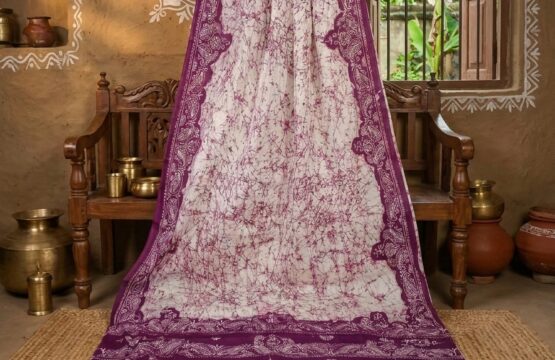
  • Base/Body Colour:  Light off-white/cream base. Which is covered in delicate batik crackle in a rich berry magenta-plum colour.
  • Border: A scalloped border in deep berry magenta/plum. Decorated with detailed white batik motifs featuring stylised lotus blossoms, curving vines, peacocks, and flowers.  
  • This pure cotton batik saree has been done with a brush also known as (tuli) instead of metal tools.
  • The technique used is Mom(candle) Batik, which means wax has been used as a resist and applied by hand.
  • Features intricate paisley border and a detailed anchal/pallu.
  • Its traditional Santiniketan Batik saree.
  • Its lightweight and simple to drape.
  • Works really well as everyday wear, or as office wear. Also can be dressed up for festive afternoons and cultural events.
  • Unstitched blouse piece included.
  • An excellent gift for her.

About This Hand-Painted Batik Saree

How batik reached Bengal

Santiniketan Batik has an unusual history for an Indian craft. It mixes the old Javanese wax dyeing method with Bengal’s nature-inspired design sense. The craft came to Visva Bharati University in the 1920s. Rabindranath Tagore discovered batik while travelling through Java and Bali.

His daughter-in-law Pratima Devi worked on it along with the French artist Andree Karpeles. Between them, they changed the very detailed Southeast Asian wax resist method into something looser and more expressive. It became a brush painting style, and thus was born the Bengal Batik saree.  That change is what you are holding here.

What Sorutuli and Mom batik actually mean

Javanese batik artists use a tool called the canting. Santiniketan artists mostly use paintbrushes to put the hot wax down, so the designs look bold and fluid and very clearly handmade. Sorutuli work uses a fine brush, so the lines stay thin and neat. 

The motifs and the colour palette

The motifs usually come from nature and from local Bengali life. Lotus flowers, peacocks, fish and the kolka, or paisley, are the ones you see again and again. Santiniketani Batik also sticks to soft, earthy shades that’s a big part of why these sarees look artistic rather than flashy.

How to tell hand-painted batik from printed batik

One thing worth knowing before you buy any hand-painted batik saree: the technique matters more than the look. There are four common ones. Block printing, hand-drawn batik, screen printing and tie-dye. On a shelf, they can seem fairly similar. They are not. Each method behaves differently in terms of durability, texture and finish, and hand-drawn batik takes the most skill and the most time of the four.

Where else you will see this craft

Santiniketan Batik is mostly done on natural fabrics such as cotton and silk. You will find it on sarees, scarves and dupattas. It also turns up on cushion covers, wall hangings and bedspreads. Its most famous use is probably on leather, in those batik-embossed Santiniketan bags, wallets and clutches that almost everyone in Bengal has owned at some point. The craft still pays the bills for a lot of rural artisans around Santiniketan in West Bengal. Buying a piece like this keeps a hundred-year-old link between India and Indonesia going.

A note on the saree itself

The saree is one of the oldest clothes still worn anywhere in the world. Unstitched drapes like it appear in Indian sculpture and writing from more than two thousand years ago. Bengal’s part in that long story has always been fine cotton, from the famous Dhaka muslins down to the molmul cottons still woven today. So this Santiniketani Batik Saree really puts two Bengali traditions together: the weaver’s cloth and the painter’s brush.

Fabric & Weaving Details Of This Bengal Batik Saree

Detail Description
Fabric Pure molmol (mulmul) cotton.
Weave Type Traditional cotton weave.
Technique Hand Mom Batik (wax resist) on pure cotton, hand-painted, Special Sorutuli Batik done with the tuli or brush method. A true pure cotton Batik saree.  
Border Beautiful batik border in the traditional Santiniketani style.
Pallu/Aanchal An elaborate, full-width deep indigo navy panel filled with repeating horizontal bands of ornate white batik linework.
Motifs Traditional Santiniketani batik motifs taken from nature and Bengali culture. Leaves, flowers and paisley are the classics of this craft. Designs are unique to each piece.
Texture Soft, breathable pure cotton with a hand-painted surface.

Saree Details

Detail Description
Colour Light off-white/cream base covered in delicate batik crackle in a rich berry magenta-plum shade.
Saree Length 5.5 meters
Blouse Piece Comes with a matching unstitched blouse piece
Transparency Slightly Opaque.
Weight Lightweight
Width 1.06 meters (106cms, 41.73 inches approx)

Disclaimer: The colour may vary slightly due to photographic lighting conditions and differences

When & How to Wear This Pure Cotton Batik Saree

  • Daytime cultural programmes, recitals and book launches.
  • Office, if you would rather wear handloom than polyester.
  • Poila Boishakh, Saraswati Puja, and the quieter days of Durga Puja.
  • Gallery openings, museum visits and craft fairs, where hand-painted work gets noticed.
  • Family lunches and small get-togethers.
  • Summer weddings and mehendi mornings, where cotton is a relief.
  • Travel days and photoshoots, because cotton looks lovely in daylight.

At 5.5 metres, this Bengal Batik saree has plenty of fabric, so this saree can take a Bengali aatpoure drape, a regular nivi, or a seedha pallu without any trouble. Cotton holds its pleats well if you starch it lightly first, so use a light starch and a low iron if you want sharp pleats. Since the anchal has most of the painting on it, let it fall open and flat over your shoulder. Do not pin it into a tight pleat. You will hide the best part of the saree.

Styling Suggestion: Pair it with

Styling a pure cotton Batik saree is effortless

  • A plain cotton or khadi blouse in a deep shade if you want the Shantiniketani batik to do the talking, or the blouse piece it comes with for a matched look.
  • A boat-neck or balloon-sleeve square-neck blouse with three-quarter sleeves. This is the neckline that suits earthy hand-painted cotton best.
  • Oxidised silver, dhokra, terracotta or brass jewellery.
  • A loose low bun or a plain braid. Add flowers if the occasion calls for it.
  • Kajal, a nude or berry lip, and a bold bindi. Nothing heavier is needed.
  • A Santiniketani batik leather bag, which comes from this same craft, or a jute or kantha stitch potli.

Jewellery that goes with the saree explained in detail:

  • Pick handmade and matte pieces.
  • Oxidised silver is the easiest answer.
  • Either one chunky neckpiece with a plain neckline or long jhumkas with your hair tied back.
  • Dhokra brass, terracotta and beaten copper will work too, mainly because they have the same handmade texture as your saree.
  • If you want to wear gold, pick antique or temple-finish gold. Stop at one piece.
  • Glass, coloured metallic or lac bangles with a silver kada or two finish the look nicely.

Footwear:

  • Flats work best with a cotton saree.
  • Kolhapuri chappals, juttis or plain leather sandals keep you comfortable.
  • For an evening event, a low block heel in brown, bronze or black leather will add a little height without overpowering the handmade feel of the saree.
  • Skip anything glossy or heavily embellished. It fights with the handmade feel of the batik.

Care & Maintenance

  • Dry wash is recommended.
  •  Especially for the first wash. It will help protect your hand-painted batik saree.
  • Do not soak, bleach or brush the fabric.
  • Wash separately, since hand-dyed cotton can let go of a little colour.
  • Do not squeeze or wring it. Press the water out gently.
  • For colours to stay bright dry in the shade, not in direct sun.
  • Use a low heat setting on the iron, if pressing at home.
  • Store the saree flat.

Shipping, Delivery, Returns & Duties

  • Standard delivery is 15-20 days.
  • Please check the estimated delivery time at checkout, as it varies based on your shipping address and our current processing time.
  • You will receive a tracking number once your order is shipped.
  • For details on returning or exchanging your saree, please consult our comprehensive Returns Policy page.
  • Customers are responsible for any applicable import duties or taxes levied by their country.

Other Categories  

Beauty | Wellness | Instant Food | Delicacies | Snacks | Staples | Men’s Neck T-shirt | Men’s Nike Shoes | Men’s Shirts | Men’s Sunglasses | Women’s Sarees | Women’s Chudidhars | Women’s Dress | Women’s Kurti | Baby

Reviews:

Add a review
Santiniketani Batik Saree Santiniketani Batik Saree
Rating*
0/5
* Rating is required
Your review
* Review is required
Name
* Name is required
Add photos or video to your review
* Please tick the checkbox to proceed
0.0
Based on 0 reviews
5
0%
4
0%
3
0%
2
0%
1
0%
0 of 0 reviews

Sorry, no reviews match your current selections

Filter

Product categories -

Product Color -

  • Yellow
  • Black
  • Blue
  • Brown
  • Gold
  • Green
  • Pink
  • Red

Product Size -

  • L
  • M
  • Onesize
  • S
  • XL
  • XXL
  • XXXL