

Potochitra Jamdani Saree {Royal Procession}
- Deep Olive Green base colour.
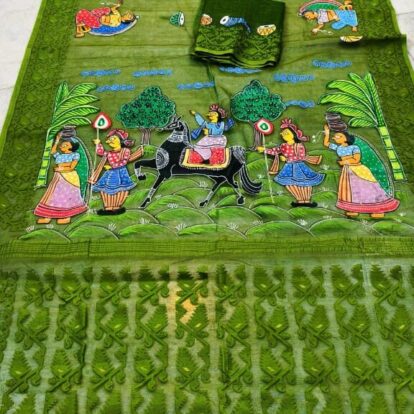
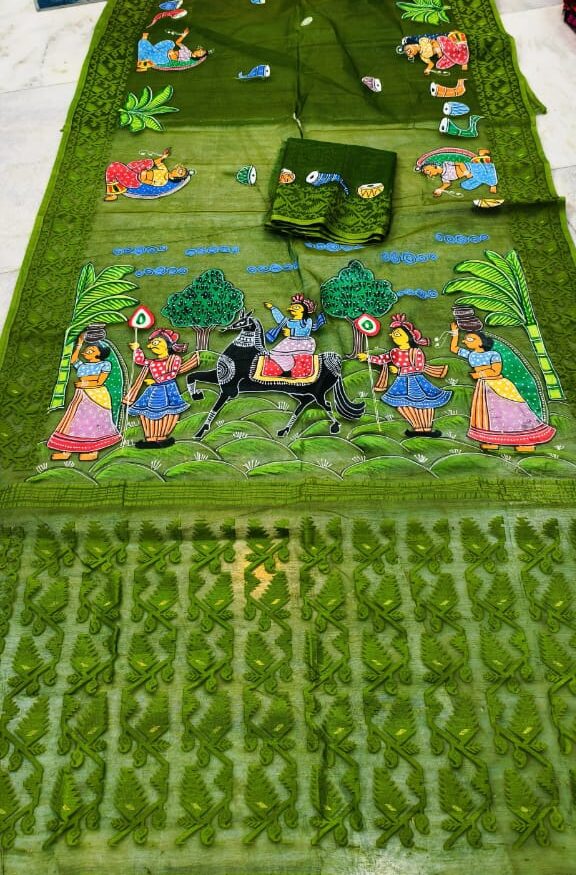
- The pallu features a hand-painted king like figure or nobleman riding a grand black horse. This shows the arrival of a special guest or deity during a grand celebration.
- The Musical Escort: Surrounding the horse, the painting shows devotees and villagers dressed in colorful traditional attire. They are depicted with instruments and festive flags, capturing the energy of a street procession.
- On both sides of the main scene, women are shown carrying pots on their heads a classic symbol of daily village life and nature. The background is painted with green trees, hills and big banyan trees, creating a serene, natural environment for the story.
- Along the body of the saree, hand-painted motifs of musical instruments continue the feel of festivities.
- Self colour Jamdani weave with tiny yellow accents.
- Specially made for Durga Puja, cultural events, and big traditional celebrations.
- Vibe: traditional, fun, very “conversation starter”.
- Specially made for Durga Puja, cultural events, and big traditional celebrations.
- The saree has a matching running blouse piece.
About This Potochitra Jamdani Saree
Presenting to you a saree which is a mix of two famous traditional arts: Jamdani weaving and Potochitra painting (Potochitra is another way of saying Patachitra). The artwork on this saree is that of a Royal Procession. The central figure on the pallu shows a nobleman or deity riding a black horse, a symbol of dignity and the arrival of an auspicious event. On the edges of the story, women are depicted carrying water pots (Kalash) on their heads, which signifies the flow of life and the abundance of the harvest season. The entire scene is set against a backdrop of hand-painted Banana trees and tropical palms, which are used in village rituals to signify growth and welcome positive energy.
What “Potochitra” means
Patta / Pot = cloth (or cloth scroll); Chitra = picture
Potochitra/Patachitra thus signifies “a painting on fabric.” This art style is very famous in Eastern India and Bangladesh, and it is revered as a mode of telling stories using painting. Creating a wearable form of hand-painted textile art.
How Potochitra painting is made (Techniques)
Traditional Patachitra is made with a proper process:
- Cloth preparation: The cloth is prepared using special mixtures that help the cloth become smoother and ready for painting.
- Drawing the outline: The main figures are drawn by trained artists using a brush.
- Filling colours: Different fabric-safe colours are filled inside the shapes accordingly.
- Final bold lining: The whole design gets a final dark outline. So all the figures and drawings look sharp and stand out.
- Finishing layer: Usually, a protective coating is used on top to protect the painting and help it last longer.
What is Jamdani, and how is it made?
Jamdani is a famous hand-loom weaving style. In Jamdani, designs are made while weaving by adding extra threads by hand. This is called a supplementary weft technique. That is why Jamdani looks light and detailed, but it takes a lot of time and skill. In this saree, the repeated motifs are woven Jamdani work, while the royal procession is painted Potochitra work. Thus, a Potochitra Jamdani saree is special as it combines weaving + painting in one outfit.
Jamdani gives the saree its woven patterns, and Potochitra adds hand-painted storytelling. Together, it becomes a saree that looks festive and also shows culture.
Fabric & Weaving Details
| Detail | Description |
| Fabric | Premium Jamdani Saree known for its fine texture, crisp feel, and airy elegance. |
| Work | Hand-Painted Potochitra (Folk art style). A deep olive green, semi-transparent body serves as the perfect canvas for the multi-colored Potochitra art. |
| Border | The saree is framed by a rich, olive green border featuring traditional Jamdani cutwork. Scattered along the deep olive green cutwork border are hand-painted figures that continue the village festival theme. You can see dancers in various poses, small folk characters doing activities, small leafy sprigs to balance the empty space and musicians playing instruments like the Dholak, making the entire drape feel alive with movement. |
| Pallu/Anchal | A royal rider on a black horse in the center. On both sides, there are attendants in traditional outfits carrying flags and pots, like a celebration or procession. The background has green hills/grass, big trees, and tall leafy plants, which gives it a village-festival feel. This scene looks like a folk painting of a “grand entry” moment, the kind you see in old stories and traditional celebrations. |
| Motifs | The saree is adorned with painted motifs from the procession: traditional drums (Dholaks), hand cymbals, dancers, and folk characters, creating a continuous narrative. |
| Texture | Sophisticated, slightly crisp yet smooth texture that provides an elegant drape for all body types. |
Saree Details
| Detail | Description |
| Colour | Deep Olive Green (with multi-color hand-painted artwork). |
| Saree Length | 5.5 meters |
| Blouse Piece | Matching blouse piece with intricate work. |
| Transparency | Slightly Transparent. |
| Weight | Lightweight. |
| Width | 1.06 meters (approx.) |
Disclaimer: The colour may vary slightly due to photographic lighting conditions and differences in device screen resolution.
When & How to Wear Potochitra Jamdani Saree
- Where to wear: This is the ultimate saree for Durga Puja (especially for Ashtami or Dashami). It also works great for any cultural event where you want to stand out.
- Day or Night: It looks bright and clean during the day for morning prayers, but the green colour really “pops” at night under party lights.
- Styling: Wear it with a red “bindi” and gold jewelry to get that perfect traditional look.
- How to drape: A traditional Bengali-style drape would look amazing to show off the hand-painted celebration pallu.
- Ornaments to pair: Gold jewellery looks the most natural with this. You can also wear temple jewellery if you want a more festive Bengali vibe.
- Footwear: Simple heels, wedges, or even traditional juttis work well.
Care & Maintenance
- Dry wash is mandatory.
- Do not machine wash or squeeze; the threads are delicate and require professional care.
- Store the saree flat, rolled in a breathable muslin cloth.
- When doing self-ironing, please use a low heat setting on the iron.
Shipping, Delivery, Returns & Duties
- Standard delivery is around 15-20 days.
- Globelink.shop takes care of all paperwork and customs clearance so your saree lands safely at your doorstep in Australia.
- You will receive a tracking number once your order is shipped.
- For details on returning or exchanging your saree, please consult our Returns Policy page.
- You shop and sit back; we ensure a hassle-free doorstep delivery.
Customer Reviews
The painting on the horse is so detailed! I love how this saree tells a real story of village life. It’s light, easy to drape, and the green is very refreshing.– Amrita Jha
I bought this for a cultural festival and received so many compliments on the unique art. The combination of Jamdani weaving and Potochitra painting is truly special.– Divya Menon
The quality is excellent. It’s a very comfortable saree for a long event, and the hand-painted figures make it a total conversation starter. Highly recommend!– Kavita R.
Other Categories
Beauty | Wellness | Instant Food | Delicacies | Snacks | Staples | Men’s Neck T-shirt | Men’s Nike Shoes | Men’s Shirts | Men’s Sunglasses | Women’s Sarees | Women’s Chudidhars | Women’s Dress | Women’s Kurti | Baby
Potochitra Jamdani Saree {Royal Procession}
- Deep Olive Green base colour.
- The pallu features a hand-painted king like figure or nobleman riding a grand black horse. This shows the arrival of a special guest or deity during a grand celebration.
- The Musical Escort: Surrounding the horse, the painting shows devotees and villagers dressed in colorful traditional attire. They are depicted with instruments and festive flags, capturing the energy of a street procession.
- On both sides of the main scene, women are shown carrying pots on their heads a classic symbol of daily village life and nature. The background is painted with green trees, hills and big banyan trees, creating a serene, natural environment for the story.
- Along the body of the saree, hand-painted motifs of musical instruments continue the feel of festivities.
- Self colour Jamdani weave with tiny yellow accents.
- Specially made for Durga Puja, cultural events, and big traditional celebrations.
- Vibe: traditional, fun, very “conversation starter”.
- Specially made for Durga Puja, cultural events, and big traditional celebrations.
- The saree has a matching running blouse piece.
About This Potochitra Jamdani Saree
Presenting to you a saree which is a mix of two famous traditional arts: Jamdani weaving and Potochitra painting (Potochitra is another way of saying Patachitra). The artwork on this saree is that of a Royal Procession. The central figure on the pallu shows a nobleman or deity riding a black horse, a symbol of dignity and the arrival of an auspicious event. On the edges of the story, women are depicted carrying water pots (Kalash) on their heads, which signifies the flow of life and the abundance of the harvest season. The entire scene is set against a backdrop of hand-painted Banana trees and tropical palms, which are used in village rituals to signify growth and welcome positive energy.
What “Potochitra” means
Patta / Pot = cloth (or cloth scroll); Chitra = picture
Potochitra/Patachitra thus signifies “a painting on fabric.” This art style is very famous in Eastern India and Bangladesh, and it is revered as a mode of telling stories using painting. Creating a wearable form of hand-painted textile art.
How Potochitra painting is made (Techniques)
Traditional Patachitra is made with a proper process:
- Cloth preparation: The cloth is prepared using special mixtures that help the cloth become smoother and ready for painting.
- Drawing the outline: The main figures are drawn by trained artists using a brush.
- Filling colours: Different fabric-safe colours are filled inside the shapes accordingly.
- Final bold lining: The whole design gets a final dark outline. So all the figures and drawings look sharp and stand out.
- Finishing layer: Usually, a protective coating is used on top to protect the painting and help it last longer.
What is Jamdani, and how is it made?
Jamdani is a famous hand-loom weaving style. In Jamdani, designs are made while weaving by adding extra threads by hand. This is called a supplementary weft technique. That is why Jamdani looks light and detailed, but it takes a lot of time and skill. In this saree, the repeated motifs are woven Jamdani work, while the royal procession is painted Potochitra work. Thus, a Potochitra Jamdani saree is special as it combines weaving + painting in one outfit.
Jamdani gives the saree its woven patterns, and Potochitra adds hand-painted storytelling. Together, it becomes a saree that looks festive and also shows culture.
Fabric & Weaving Details
| Detail | Description |
| Fabric | Premium Jamdani Saree known for its fine texture, crisp feel, and airy elegance. |
| Work | Hand-Painted Potochitra (Folk art style). A deep olive green, semi-transparent body serves as the perfect canvas for the multi-colored Potochitra art. |
| Border | The saree is framed by a rich, olive green border featuring traditional Jamdani cutwork. Scattered along the deep olive green cutwork border are hand-painted figures that continue the village festival theme. You can see dancers in various poses, small folk characters doing activities, small leafy sprigs to balance the empty space and musicians playing instruments like the Dholak, making the entire drape feel alive with movement. |
| Pallu/Anchal | A royal rider on a black horse in the center. On both sides, there are attendants in traditional outfits carrying flags and pots, like a celebration or procession. The background has green hills/grass, big trees, and tall leafy plants, which gives it a village-festival feel. This scene looks like a folk painting of a “grand entry” moment, the kind you see in old stories and traditional celebrations. |
| Motifs | The saree is adorned with painted motifs from the procession: traditional drums (Dholaks), hand cymbals, dancers, and folk characters, creating a continuous narrative. |
| Texture | Sophisticated, slightly crisp yet smooth texture that provides an elegant drape for all body types. |
Saree Details
| Detail | Description |
| Colour | Deep Olive Green (with multi-color hand-painted artwork). |
| Saree Length | 5.5 meters |
| Blouse Piece | Matching blouse piece with intricate work. |
| Transparency | Slightly Transparent. |
| Weight | Lightweight. |
| Width | 1.06 meters (approx.) |
Disclaimer: The colour may vary slightly due to photographic lighting conditions and differences in device screen resolution.
When & How to Wear Potochitra Jamdani Saree
- Where to wear: This is the ultimate saree for Durga Puja (especially for Ashtami or Dashami). It also works great for any cultural event where you want to stand out.
- Day or Night: It looks bright and clean during the day for morning prayers, but the green colour really “pops” at night under party lights.
- Styling: Wear it with a red “bindi” and gold jewelry to get that perfect traditional look.
- How to drape: A traditional Bengali-style drape would look amazing to show off the hand-painted celebration pallu.
- Ornaments to pair: Gold jewellery looks the most natural with this. You can also wear temple jewellery if you want a more festive Bengali vibe.
- Footwear: Simple heels, wedges, or even traditional juttis work well.
Care & Maintenance
- Dry wash is mandatory.
- Do not machine wash or squeeze; the threads are delicate and require professional care.
- Store the saree flat, rolled in a breathable muslin cloth.
- When doing self-ironing, please use a low heat setting on the iron.
Shipping, Delivery, Returns & Duties
- Standard delivery is around 15-20 days.
- Globelink.shop takes care of all paperwork and customs clearance so your saree lands safely at your doorstep in Australia.
- You will receive a tracking number once your order is shipped.
- For details on returning or exchanging your saree, please consult our Returns Policy page.
- You shop and sit back; we ensure a hassle-free doorstep delivery.
Customer Reviews
The painting on the horse is so detailed! I love how this saree tells a real story of village life. It’s light, easy to drape, and the green is very refreshing.– Amrita Jha
I bought this for a cultural festival and received so many compliments on the unique art. The combination of Jamdani weaving and Potochitra painting is truly special.– Divya Menon
The quality is excellent. It’s a very comfortable saree for a long event, and the hand-painted figures make it a total conversation starter. Highly recommend!– Kavita R.
Other Categories
Beauty | Wellness | Instant Food | Delicacies | Snacks | Staples | Men’s Neck T-shirt | Men’s Nike Shoes | Men’s Shirts | Men’s Sunglasses | Women’s Sarees | Women’s Chudidhars | Women’s Dress | Women’s Kurti | Baby
Related products