

Potochitra Jamdani Saree (Pichwai-Inspired Potochitra Painting “Sacred Cow & Lotus Garden”)
- Off-white/Ivory base colour.
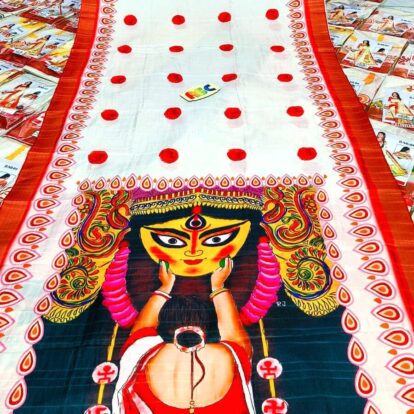
- This saree is a beautiful blend where the Pichwai art of the West meets the Jamdani weaving and Potochitra hand-painting skills of the East.
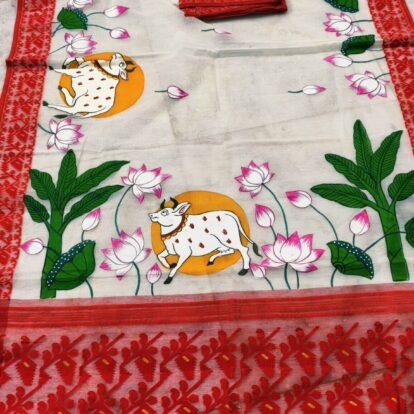
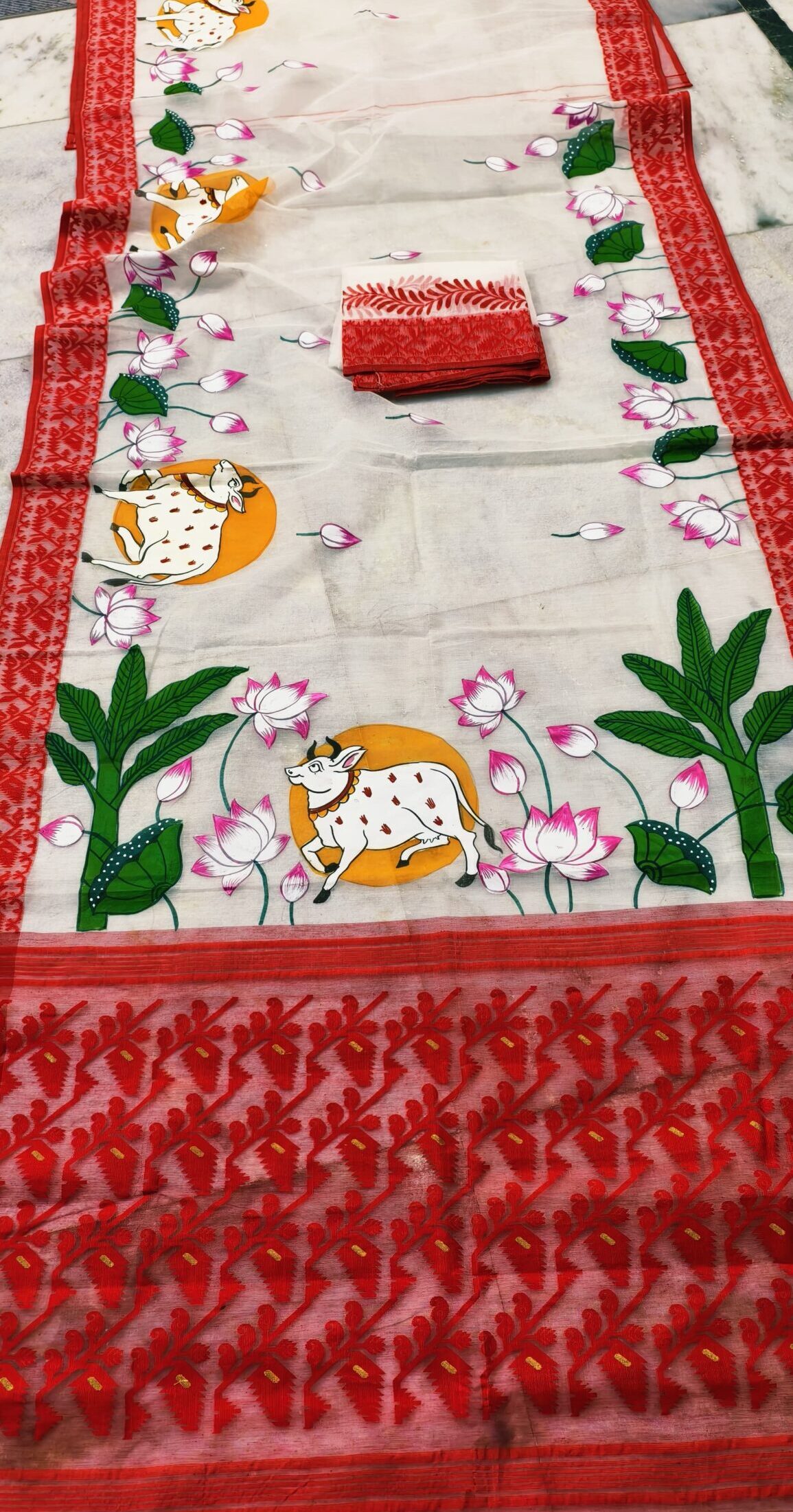
- The painting on the pallu, the sacred cow (Kamadhenu) and the Lotus is the hallmark of Pichwai art. This art was traditionally done in Nathdwara(Rajasthan) to decorate the walls behind deities in temples.
- Adorned with traditional tiny beautiful red handprints and a golden-yellow halo, the cow represents selfless love, motherhood, and divine abundance.
- The Blooming Lotus Path: Each cow is surrounded by a lush trail of vibrant pink Lotuses. In Pichwai tradition, the lotus signifies the heart’s devotion and spiritual enlightenment, showing beauty rising from the earthly plane.
- The Trees of Life: Majestic Banana trees are painted on either side, on the pallu. A symbol common to both Pichwai and Potochitra art. These trees represent fertility and the lushness of the sacred groves where the deities are said to wander.
- Artwork tones: white cow, golden/orange round circles, pink lotuses, deep green leaves (very fresh and festive)
- The overall design is bold because of the red border, but the white base keeps it looking clean and elegant.
- Specially made for cultural events, and big traditional celebrations.
- The saree has a matching running blouse piece.
About This Potochitra Jamdani Saree
Presenting to you a saree which is a mix of three famous traditional arts: Pichwai Art, Jamdani weaving and Potochitra painting (Potochitra is another way of saying Patachitra). While the theme is inspired by Rajasthan’s Pichwai, the execution is done by the Patuas (Potochitra artists) of Bengal. They use their legendary hand-painting skills to bring these motifs to life on the delicate Jamdani canvas.
What “Potochitra” means
Patta / Pot = cloth (or cloth scroll); Chitra = picture
Potochitra/Patachitra thus signifies “a painting on fabric.” This art style is very famous in Eastern India and Bangladesh, and it is revered as a mode of telling stories using painting. Creating a wearable form of hand-painting.
How Potochitra painting is made (Techniques)
Traditional Patachitra is made with a proper process:
- Cloth preparation: The cloth is prepared using special mixtures that help the cloth to become smoother and ready for painting.
- Drawing the outline: The main figures are drawn by trained artists using a brush.
- Filling colours: Different fabric-safe colours are filled inside the shapes accordingly.
- Final bold lining: The whole design gets a final dark outline. So all the figures and drawings look sharp and stand out.
- Finishing layer: Usually, a protective coating is used on top to protect the painting and help it last longer.
What is Jamdani, and how is it made?
Jamdani is a famous hand-loom weaving style. In Jamdani, designs are made while weaving by adding extra threads by hand. This is called a supplementary weft technique. That is why Jamdani looks light and detailed, but it takes a lot of time and skill.In this saree, the repeated motifs on the red section are woven Jamdani work, while the central Pichwai-style narrative (featuring Kamadhenu) is executed in Potochitra painting. Thus, a Potochitra Jamdani saree is special as it combines weaving + painting in one outfit.
Jamdani gives the saree its woven patterns, and Potochitra adds hand-painted storytelling. Together, it becomes a saree that looks festive and also shows culture.
Fabric & Weaving Details
| Detail | Description |
| Fabric | Premium Jamdani (High-quality weaving). |
| Weave Type | Jamdani weaving. The designs are created during weaving itself, not printed later. That’s why it looks so fine and detailed. |
| Work | Hand-Painted Fusion: Pichwai-style motifs rendered through traditional Potochitra hand-painting techniques. |
| Border | An auspicious Red Jamdani cutwork border featuring geometric floral patterns that frame the sacred story Of the Kamdhenu(cow) and the divine lotuses painted in the Potochitra style. |
| Pallu/Anchal | The pallu features dense, traditional Jamdani weaving that adds a rich textural weight to the airy saree. It is on top of this woven ground that the Pichwai painting comes alive.
A white sacred cow is painted inside a warm golden/orange circle (like a sun/halo disc). Around it is seen a lotus pond vibe: lotus blooms + buds placed like they’re rising from water. On the sides, there are tall green Banana plant motifs, which makes the scene feel like a village garden. This theme fits Pichwai mood well because cows and lotus gardens are classic devotional and nature symbols used in Pichwai compositions. |
| Motifs | The center body is kept mostly clean, and small lotus flower buds in white and pink are are present. But they are spaced out, giving the saree a airy look while lending a festive touch. |
| Texture | Slightly stiff but airy (characteristic of Jamdani) |
Saree Details
| Detail | Description |
| Colour | Off-white/Ivory base with red border made of woven motifs. |
| Saree Length | 5.5 meters |
| Blouse Piece | Matching blouse piece with woven Jamdani border and hand-painted motif |
| Transparency | Slightly Transparent. |
| Weight | Lightweight. |
| Width | 1.06 meters (approx.) |
Disclaimer: The colour may vary slightly due to photographic lighting conditions and differences in device screen resolution.
When & How to Wear Potochitra Jamdani Saree
- Where to wear: This saree is a beautiful choice for morning prayers and temple visits because of its holy designs. Its classic red and white look also makes it perfect for daytime weddings and special cultural parties.
- Day or Night: It looks bright and clean during the day for morning prayers, but the red border really “pops” at night under party lights.
- Styling: Wear it with a red “bindi” and gold jewelry to get that perfect traditional look.
- How to drape: Drape it to elegantly display the painted pallu. A classic Gujarati or Rajasthani-style drape could beautifully complement the art’s origins, or wear it in your preferred style to feature the story.
- Ornaments to pair: Gold jewellery remains perfect. Consider adding Kundan or Meenakari pieces to echo the Rajasthani inspiration of the Pichwai art.
- Footwear: Simple heels, wedges, or even traditional juttis work well.
Care & Maintenance
- Dry wash is mandatory.
- Do not machine wash or squeeze; the threads are delicate and require professional care.
- Store the saree flat, rolled in a breathable muslin cloth.
- When doing self-ironing, please use a low heat setting on the iron.
Shipping, Delivery, Returns & Duties
- Standard delivery is around 15-20 days.
- Globelink.shop takes care of all paperwork and customs clearance so your saree lands safely at your doorstep in Australia.
- You will receive a tracking number once your order is shipped.
- For details on returning or exchanging your saree, please consult our Returns Policy page.
- You shop and sit back; we ensure a hassle-free doorstep delivery.
Customer Reviews
This saree looks so pure and festive. The off-white base with the red border is a perfect puja combo. The cow and lotus design feels very peaceful, not loud, but still special.
The lotus border is my favourite thing. When I draped it, that lotus vine line looked so pretty along the edge. It gives that hand-painted feel, like a real art piece.
The red woven part makes it look expensive. I was worried it might look too light because the body is off-white, but the red jamdani-style bottom balances it beautifully. Looks rich in real life.
Other Categories
Beauty | Wellness | Instant Food | Delicacies | Snacks | Staples | Men’s Neck T-shirt | Men’s Nike Shoes | Men’s Shirts | Men’s Sunglasses | Women’s Sarees | Women’s Chudidhars | Women’s Dress | Women’s Kurti | Baby
Potochitra Jamdani Saree (Pichwai-Inspired Potochitra Painting “Sacred Cow & Lotus Garden”)
- Off-white/Ivory base colour.
- This saree is a beautiful blend where the Pichwai art of the West meets the Jamdani weaving and Potochitra hand-painting skills of the East.
- The painting on the pallu, the sacred cow (Kamadhenu) and the Lotus is the hallmark of Pichwai art. This art was traditionally done in Nathdwara(Rajasthan) to decorate the walls behind deities in temples.
- Adorned with traditional tiny beautiful red handprints and a golden-yellow halo, the cow represents selfless love, motherhood, and divine abundance.
- The Blooming Lotus Path: Each cow is surrounded by a lush trail of vibrant pink Lotuses. In Pichwai tradition, the lotus signifies the heart’s devotion and spiritual enlightenment, showing beauty rising from the earthly plane.
- The Trees of Life: Majestic Banana trees are painted on either side, on the pallu. A symbol common to both Pichwai and Potochitra art. These trees represent fertility and the lushness of the sacred groves where the deities are said to wander.
- Artwork tones: white cow, golden/orange round circles, pink lotuses, deep green leaves (very fresh and festive)
- The overall design is bold because of the red border, but the white base keeps it looking clean and elegant.
- Specially made for cultural events, and big traditional celebrations.
- The saree has a matching running blouse piece.
About This Potochitra Jamdani Saree
Presenting to you a saree which is a mix of three famous traditional arts: Pichwai Art, Jamdani weaving and Potochitra painting (Potochitra is another way of saying Patachitra). While the theme is inspired by Rajasthan’s Pichwai, the execution is done by the Patuas (Potochitra artists) of Bengal. They use their legendary hand-painting skills to bring these motifs to life on the delicate Jamdani canvas.
What “Potochitra” means
Patta / Pot = cloth (or cloth scroll); Chitra = picture
Potochitra/Patachitra thus signifies “a painting on fabric.” This art style is very famous in Eastern India and Bangladesh, and it is revered as a mode of telling stories using painting. Creating a wearable form of hand-painting.
How Potochitra painting is made (Techniques)
Traditional Patachitra is made with a proper process:
- Cloth preparation: The cloth is prepared using special mixtures that help the cloth to become smoother and ready for painting.
- Drawing the outline: The main figures are drawn by trained artists using a brush.
- Filling colours: Different fabric-safe colours are filled inside the shapes accordingly.
- Final bold lining: The whole design gets a final dark outline. So all the figures and drawings look sharp and stand out.
- Finishing layer: Usually, a protective coating is used on top to protect the painting and help it last longer.
What is Jamdani, and how is it made?
Jamdani is a famous hand-loom weaving style. In Jamdani, designs are made while weaving by adding extra threads by hand. This is called a supplementary weft technique. That is why Jamdani looks light and detailed, but it takes a lot of time and skill.In this saree, the repeated motifs on the red section are woven Jamdani work, while the central Pichwai-style narrative (featuring Kamadhenu) is executed in Potochitra painting. Thus, a Potochitra Jamdani saree is special as it combines weaving + painting in one outfit.
Jamdani gives the saree its woven patterns, and Potochitra adds hand-painted storytelling. Together, it becomes a saree that looks festive and also shows culture.
Fabric & Weaving Details
| Detail | Description |
| Fabric | Premium Jamdani (High-quality weaving). |
| Weave Type | Jamdani weaving. The designs are created during weaving itself, not printed later. That’s why it looks so fine and detailed. |
| Work | Hand-Painted Fusion: Pichwai-style motifs rendered through traditional Potochitra hand-painting techniques. |
| Border | An auspicious Red Jamdani cutwork border featuring geometric floral patterns that frame the sacred story Of the Kamdhenu(cow) and the divine lotuses painted in the Potochitra style. |
| Pallu/Anchal | The pallu features dense, traditional Jamdani weaving that adds a rich textural weight to the airy saree. It is on top of this woven ground that the Pichwai painting comes alive.
A white sacred cow is painted inside a warm golden/orange circle (like a sun/halo disc). Around it is seen a lotus pond vibe: lotus blooms + buds placed like they’re rising from water. On the sides, there are tall green Banana plant motifs, which makes the scene feel like a village garden. This theme fits Pichwai mood well because cows and lotus gardens are classic devotional and nature symbols used in Pichwai compositions. |
| Motifs | The center body is kept mostly clean, and small lotus flower buds in white and pink are are present. But they are spaced out, giving the saree a airy look while lending a festive touch. |
| Texture | Slightly stiff but airy (characteristic of Jamdani) |
Saree Details
| Detail | Description |
| Colour | Off-white/Ivory base with red border made of woven motifs. |
| Saree Length | 5.5 meters |
| Blouse Piece | Matching blouse piece with woven Jamdani border and hand-painted motif |
| Transparency | Slightly Transparent. |
| Weight | Lightweight. |
| Width | 1.06 meters (approx.) |
Disclaimer: The colour may vary slightly due to photographic lighting conditions and differences in device screen resolution.
When & How to Wear Potochitra Jamdani Saree
- Where to wear: This saree is a beautiful choice for morning prayers and temple visits because of its holy designs. Its classic red and white look also makes it perfect for daytime weddings and special cultural parties.
- Day or Night: It looks bright and clean during the day for morning prayers, but the red border really “pops” at night under party lights.
- Styling: Wear it with a red “bindi” and gold jewelry to get that perfect traditional look.
- How to drape: Drape it to elegantly display the painted pallu. A classic Gujarati or Rajasthani-style drape could beautifully complement the art’s origins, or wear it in your preferred style to feature the story.
- Ornaments to pair: Gold jewellery remains perfect. Consider adding Kundan or Meenakari pieces to echo the Rajasthani inspiration of the Pichwai art.
- Footwear: Simple heels, wedges, or even traditional juttis work well.
Care & Maintenance
- Dry wash is mandatory.
- Do not machine wash or squeeze; the threads are delicate and require professional care.
- Store the saree flat, rolled in a breathable muslin cloth.
- When doing self-ironing, please use a low heat setting on the iron.
Shipping, Delivery, Returns & Duties
- Standard delivery is around 15-20 days.
- Globelink.shop takes care of all paperwork and customs clearance so your saree lands safely at your doorstep in Australia.
- You will receive a tracking number once your order is shipped.
- For details on returning or exchanging your saree, please consult our Returns Policy page.
- You shop and sit back; we ensure a hassle-free doorstep delivery.
Customer Reviews
This saree looks so pure and festive. The off-white base with the red border is a perfect puja combo. The cow and lotus design feels very peaceful, not loud, but still special.
The lotus border is my favourite thing. When I draped it, that lotus vine line looked so pretty along the edge. It gives that hand-painted feel, like a real art piece.
The red woven part makes it look expensive. I was worried it might look too light because the body is off-white, but the red jamdani-style bottom balances it beautifully. Looks rich in real life.
Other Categories
Beauty | Wellness | Instant Food | Delicacies | Snacks | Staples | Men’s Neck T-shirt | Men’s Nike Shoes | Men’s Shirts | Men’s Sunglasses | Women’s Sarees | Women’s Chudidhars | Women’s Dress | Women’s Kurti | Baby
Related products