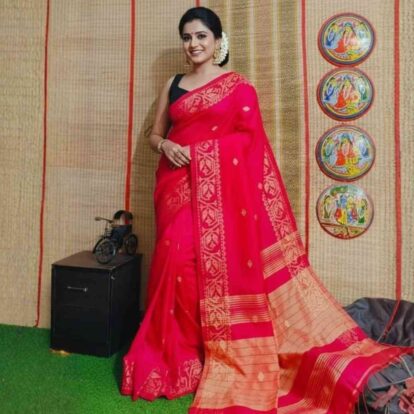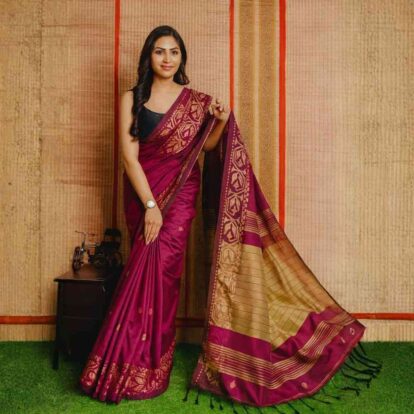


Potochitra Jamdani Saree {The Ritual of Celebration: Pandal Scene}
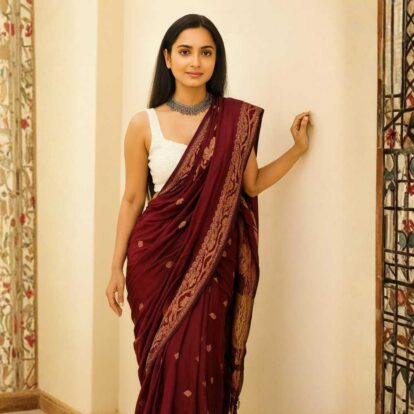
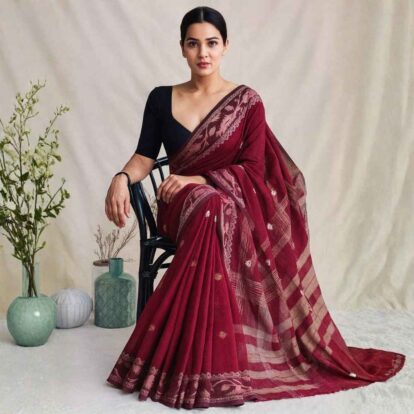
- Deep Red/Maroon base colour.
- The Power of Red: The deep red fabric is more than just a color; it symbolizes Shakti (energy) and the passion of the festival with which it is celebrated.
- The saree looks like a whole celebration.
- Jamdani weaving and Potochitra painting meet in this deep red/maroon saree. Jamdani gives the saree a traditional woven beauty, and Potochitra adds a storytelling art style.
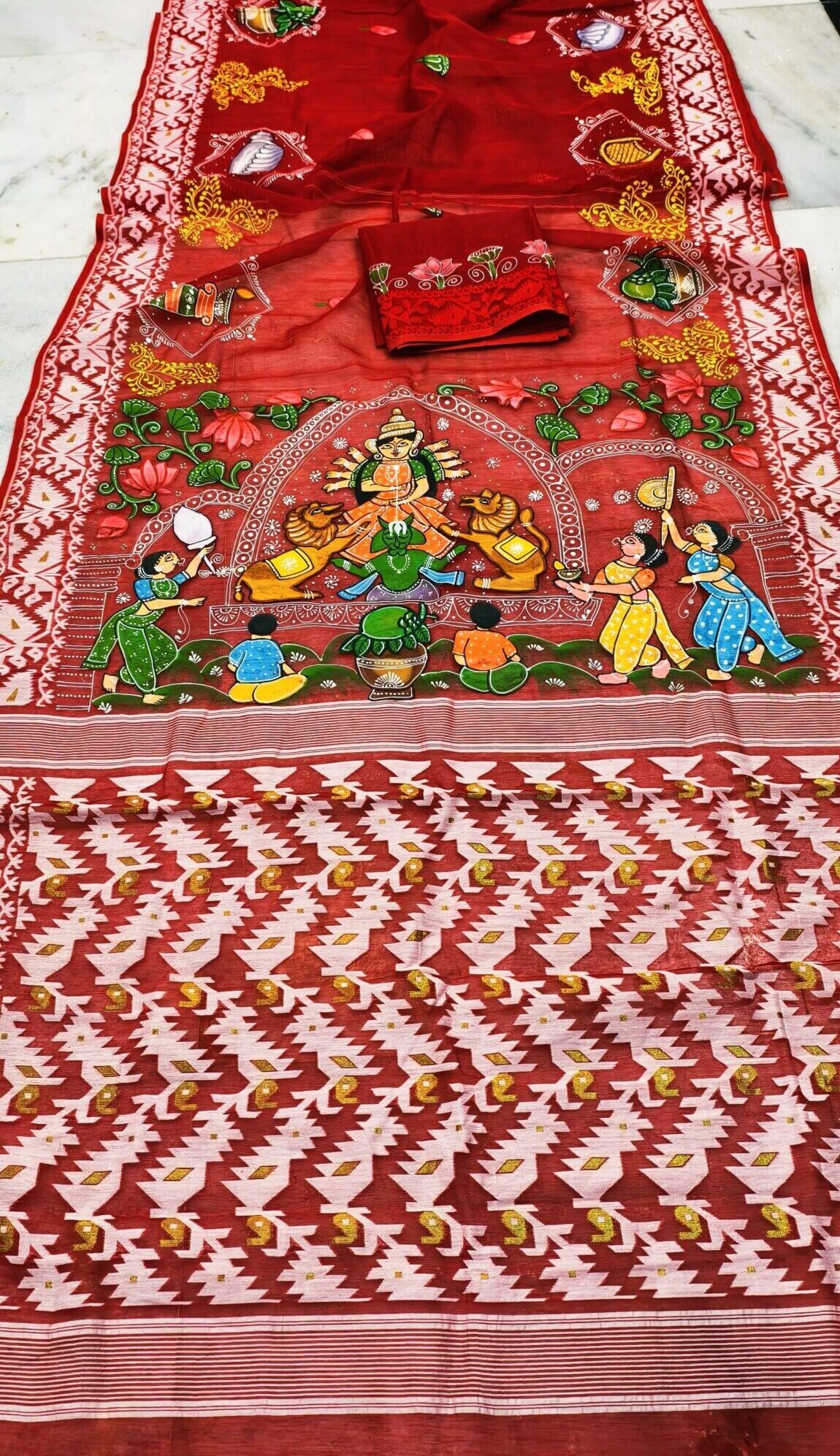
- The Potochitra painting theme: The saree has a hand-painted scene of a typical Durga Pandal. The intricate pallu is the main canvas, which features a detailed scene of Goddess Durga, her devotees, and the protective lotus blooms. Along the border length, various themes and motifs such as kalash, conch shell, intricate alpona-like design add to the festive celebratory look of the saree.
- The Sacred Lotus: On both sides of the central Durga painting, vibrant Lotus flowers are depicted in full bloom. The lotus is a symbol of purity, enlightenment, and rebirth.
- Vibe: traditional, fun, very “conversation starter”.
- Contrast work: bold white Jamdani weave with tiny gold accents
- Specially made for Durga Puja, cultural events, and big traditional celebrations.
- The saree has a matching running blouse piece.
About This Potochitra Jamdani Saree
Presenting to you a saree which is a mix of two famous traditional arts: Jamdani weaving and Potochitra painting (Potochitra is another way of saying Patachitra). The artwork on this saree illustrates the spiritual fervor of Durga Puja:The Ritual of Celebration. The Centerpiece: Shakti in Form: The large painting on the pallu depicts Goddess Durga in her regal form, flanked by her two lions. This represents the triumph of good over evil and the supreme power of the divine feminine. Surrounding the Goddess, the painting also captures devotees lost in the joy of the festival.
What “Potochitra” means
Patta / Pot = cloth (or cloth scroll); Chitra = picture
Potochitra/Patachitra thus signifies “a painting on fabric.” This art style is very famous in Eastern India and Bangladesh, and it is revered as a mode of telling stories using painting. Creating a wearable form of hand-painted textile art.
How Potochitra painting is made (Techniques)
Traditional Patachitra is made with a proper process:
- Cloth preparation: The cloth is prepared using special mixtures that help the cloth become smoother and ready for painting.
- Drawing the outline: The main figures are drawn by trained artists using a brush.
- Filling colours: Different fabric-safe colours are filled inside the shapes accordingly.
- Final bold lining: The whole design gets a final dark outline. So all the figures and drawings look sharp and stand out.
- Finishing layer: Usually, a protective coating is used on top to protect the painting and help it last longer.
What is Jamdani, and how is it made?
Jamdani is a famous hand-loom weaving style. In Jamdani, designs are made while weaving by adding extra threads by hand. This is called a supplementary weft technique. That is why Jamdani looks light and detailed, but it takes a lot of time and skill. In this saree, the repeated motifs are woven Jamdani work, while the Ritual of celebration during Durga Puja is painted Potochitra work. Thus, a Potochitra Jamdani saree is special as it combines weaving + painting in one outfit.
Jamdani gives the saree its woven patterns, and Potochitra adds hand-painted storytelling. Together, it becomes a saree that looks festive and also shows culture.
Fabric & Weaving Details
| Detail | Description |
| Fabric | Premium Jamdani Saree known for its fine texture, crisp feel, and airy elegance. |
| Weave Type | Jamdani weaving. The designs are created during weaving itself, not printed later. That’s why it looks so fine and detailed. |
| Work | Hand-Painted Potochitra (Folk art style). A deep red, semi-transparent body serves as the perfect canvas for the multi-colored Potochitra art. |
| Border | It has a repeated white geometric pattern (zigzag/chevron style) across the red base. Inside the pattern, you can see tiny gold/yellow leaf-like dots placed evenly, so it looks rich but still neat. |
| Pallu/Anchal | This is the strongest woven section. This is the kind of weaving that looks even better when you see it up close. This creates a strong base for the “The Ritual of celebration” Potochitra painting. |
| Motifs | On the main body of the saree, there are green vines and pink lotus-like flowers that run across the border area. This softens the heavy red and adds a festive “garden” feel. On the upper red section, you can spot: kalash/pot style symbols, conch (shankh) type shapes, diya/lamp style icons. Lot of Alpona inspired designs are present throughout. These are the classic puja symbols, so the saree looks very theme-based. |
| Texture | Sophisticated, slightly crisp yet smooth texture that provides an elegant drape for all body types. |
Saree Details
| Detail | Description |
| Colour | Wine red/deep maroon (with multi-color hand-painted artwork). |
| Saree Length | 5.5 meters |
| Blouse Piece | Matching blouse piece with intricate work. |
| Transparency | Slightly Transparent. |
| Weight | Lightweight. |
| Width | 1.06 meters (approx.) |
Disclaimer: The colour may vary slightly due to photographic lighting conditions and differences in device screen resolution.
When & How to Wear Potochitra Jamdani Saree
- Where to wear: This is the ultimate saree for Durga Puja (especially for Ashtami or Dashami). It also works great for any cultural event where you want to stand out.
- Day or Night: It looks bright and clean during the day for morning prayers, but the red colour really “pops” at night under party lights.
- Styling: Wear it with a red “bindi” and gold jewelry to get that perfect traditional look.
- How to drape: A traditional Bengali-style drape would look amazing to show off the hand-painted celebration pallu.
- Ornaments to pair: Gold jewellery looks the most natural with this. You can also wear temple jewellery if you want a more festive Bengali vibe.
- Footwear: Simple heels, wedges, or even traditional juttis work well.
Care & Maintenance
- Dry wash is mandatory.
- Do not machine wash or squeeze; the threads are delicate and require professional care.
- Store the saree flat, rolled in a breathable muslin cloth.
- When doing self-ironing, please use a low heat setting on the iron.
Shipping, Delivery, Returns & Duties
- Standard delivery is around 15-20 days.
- Globelink.shop takes care of all paperwork and customs clearance so your saree lands safely at your doorstep in Australia.
- You will receive a tracking number once your order is shipped.
- For details on returning or exchanging your saree, please consult our Returns Policy page.
- You shop and sit back; we ensure a hassle-free doorstep delivery.
Customer Reviews
The pallu painting is so eye-catching. Everyone kept looking at it and asking what the scene is. The red colour is deep and festive, not loud. Perfect for puja days.-Monalisa Kutti
The weaving is the real surprise. Photos show the painting, but in real life the jamdani pattern on the lower part looks super premium. The white work and those tiny gold bits make it look expensive. It’s a proper statement saree.– Deboshree Dutta
If you want traditional but not boring, this is it. I loved that the body has small motifs and then the big artwork comes on the pallu. It feels like wearing a story. I kept my blouse simple and still got so many compliments.– Divya Rastogi
Other Categories
Beauty | Wellness | Instant Food | Delicacies | Snacks | Staples | Men’s Neck T-shirt | Men’s Nike Shoes | Men’s Shirts | Men’s Sunglasses | Women’s Sarees | Women’s Chudidhars | Women’s Dress | Women’s Kurti | Baby
Potochitra Jamdani Saree {The Ritual of Celebration: Pandal Scene}
- Deep Red/Maroon base colour.
- The Power of Red: The deep red fabric is more than just a color; it symbolizes Shakti (energy) and the passion of the festival with which it is celebrated.
- The saree looks like a whole celebration.
- Jamdani weaving and Potochitra painting meet in this deep red/maroon saree. Jamdani gives the saree a traditional woven beauty, and Potochitra adds a storytelling art style.
- The Potochitra painting theme: The saree has a hand-painted scene of a typical Durga Pandal. The intricate pallu is the main canvas, which features a detailed scene of Goddess Durga, her devotees, and the protective lotus blooms. Along the border length, various themes and motifs such as kalash, conch shell, intricate alpona-like design add to the festive celebratory look of the saree.
- The Sacred Lotus: On both sides of the central Durga painting, vibrant Lotus flowers are depicted in full bloom. The lotus is a symbol of purity, enlightenment, and rebirth.
- Vibe: traditional, fun, very “conversation starter”.
- Contrast work: bold white Jamdani weave with tiny gold accents
- Specially made for Durga Puja, cultural events, and big traditional celebrations.
- The saree has a matching running blouse piece.
About This Potochitra Jamdani Saree
Presenting to you a saree which is a mix of two famous traditional arts: Jamdani weaving and Potochitra painting (Potochitra is another way of saying Patachitra). The artwork on this saree illustrates the spiritual fervor of Durga Puja:The Ritual of Celebration. The Centerpiece: Shakti in Form: The large painting on the pallu depicts Goddess Durga in her regal form, flanked by her two lions. This represents the triumph of good over evil and the supreme power of the divine feminine. Surrounding the Goddess, the painting also captures devotees lost in the joy of the festival.
What “Potochitra” means
Patta / Pot = cloth (or cloth scroll); Chitra = picture
Potochitra/Patachitra thus signifies “a painting on fabric.” This art style is very famous in Eastern India and Bangladesh, and it is revered as a mode of telling stories using painting. Creating a wearable form of hand-painted textile art.
How Potochitra painting is made (Techniques)
Traditional Patachitra is made with a proper process:
- Cloth preparation: The cloth is prepared using special mixtures that help the cloth become smoother and ready for painting.
- Drawing the outline: The main figures are drawn by trained artists using a brush.
- Filling colours: Different fabric-safe colours are filled inside the shapes accordingly.
- Final bold lining: The whole design gets a final dark outline. So all the figures and drawings look sharp and stand out.
- Finishing layer: Usually, a protective coating is used on top to protect the painting and help it last longer.
What is Jamdani, and how is it made?
Jamdani is a famous hand-loom weaving style. In Jamdani, designs are made while weaving by adding extra threads by hand. This is called a supplementary weft technique. That is why Jamdani looks light and detailed, but it takes a lot of time and skill. In this saree, the repeated motifs are woven Jamdani work, while the Ritual of celebration during Durga Puja is painted Potochitra work. Thus, a Potochitra Jamdani saree is special as it combines weaving + painting in one outfit.
Jamdani gives the saree its woven patterns, and Potochitra adds hand-painted storytelling. Together, it becomes a saree that looks festive and also shows culture.
Fabric & Weaving Details
| Detail | Description |
| Fabric | Premium Jamdani Saree known for its fine texture, crisp feel, and airy elegance. |
| Weave Type | Jamdani weaving. The designs are created during weaving itself, not printed later. That’s why it looks so fine and detailed. |
| Work | Hand-Painted Potochitra (Folk art style). A deep red, semi-transparent body serves as the perfect canvas for the multi-colored Potochitra art. |
| Border | It has a repeated white geometric pattern (zigzag/chevron style) across the red base. Inside the pattern, you can see tiny gold/yellow leaf-like dots placed evenly, so it looks rich but still neat. |
| Pallu/Anchal | This is the strongest woven section. This is the kind of weaving that looks even better when you see it up close. This creates a strong base for the “The Ritual of celebration” Potochitra painting. |
| Motifs | On the main body of the saree, there are green vines and pink lotus-like flowers that run across the border area. This softens the heavy red and adds a festive “garden” feel. On the upper red section, you can spot: kalash/pot style symbols, conch (shankh) type shapes, diya/lamp style icons. Lot of Alpona inspired designs are present throughout. These are the classic puja symbols, so the saree looks very theme-based. |
| Texture | Sophisticated, slightly crisp yet smooth texture that provides an elegant drape for all body types. |
Saree Details
| Detail | Description |
| Colour | Wine red/deep maroon (with multi-color hand-painted artwork). |
| Saree Length | 5.5 meters |
| Blouse Piece | Matching blouse piece with intricate work. |
| Transparency | Slightly Transparent. |
| Weight | Lightweight. |
| Width | 1.06 meters (approx.) |
Disclaimer: The colour may vary slightly due to photographic lighting conditions and differences in device screen resolution.
When & How to Wear Potochitra Jamdani Saree
- Where to wear: This is the ultimate saree for Durga Puja (especially for Ashtami or Dashami). It also works great for any cultural event where you want to stand out.
- Day or Night: It looks bright and clean during the day for morning prayers, but the red colour really “pops” at night under party lights.
- Styling: Wear it with a red “bindi” and gold jewelry to get that perfect traditional look.
- How to drape: A traditional Bengali-style drape would look amazing to show off the hand-painted celebration pallu.
- Ornaments to pair: Gold jewellery looks the most natural with this. You can also wear temple jewellery if you want a more festive Bengali vibe.
- Footwear: Simple heels, wedges, or even traditional juttis work well.
Care & Maintenance
- Dry wash is mandatory.
- Do not machine wash or squeeze; the threads are delicate and require professional care.
- Store the saree flat, rolled in a breathable muslin cloth.
- When doing self-ironing, please use a low heat setting on the iron.
Shipping, Delivery, Returns & Duties
- Standard delivery is around 15-20 days.
- Globelink.shop takes care of all paperwork and customs clearance so your saree lands safely at your doorstep in Australia.
- You will receive a tracking number once your order is shipped.
- For details on returning or exchanging your saree, please consult our Returns Policy page.
- You shop and sit back; we ensure a hassle-free doorstep delivery.
Customer Reviews
The pallu painting is so eye-catching. Everyone kept looking at it and asking what the scene is. The red colour is deep and festive, not loud. Perfect for puja days.-Monalisa Kutti
The weaving is the real surprise. Photos show the painting, but in real life the jamdani pattern on the lower part looks super premium. The white work and those tiny gold bits make it look expensive. It’s a proper statement saree.– Deboshree Dutta
If you want traditional but not boring, this is it. I loved that the body has small motifs and then the big artwork comes on the pallu. It feels like wearing a story. I kept my blouse simple and still got so many compliments.– Divya Rastogi
Other Categories
Beauty | Wellness | Instant Food | Delicacies | Snacks | Staples | Men’s Neck T-shirt | Men’s Nike Shoes | Men’s Shirts | Men’s Sunglasses | Women’s Sarees | Women’s Chudidhars | Women’s Dress | Women’s Kurti | Baby
Related products